
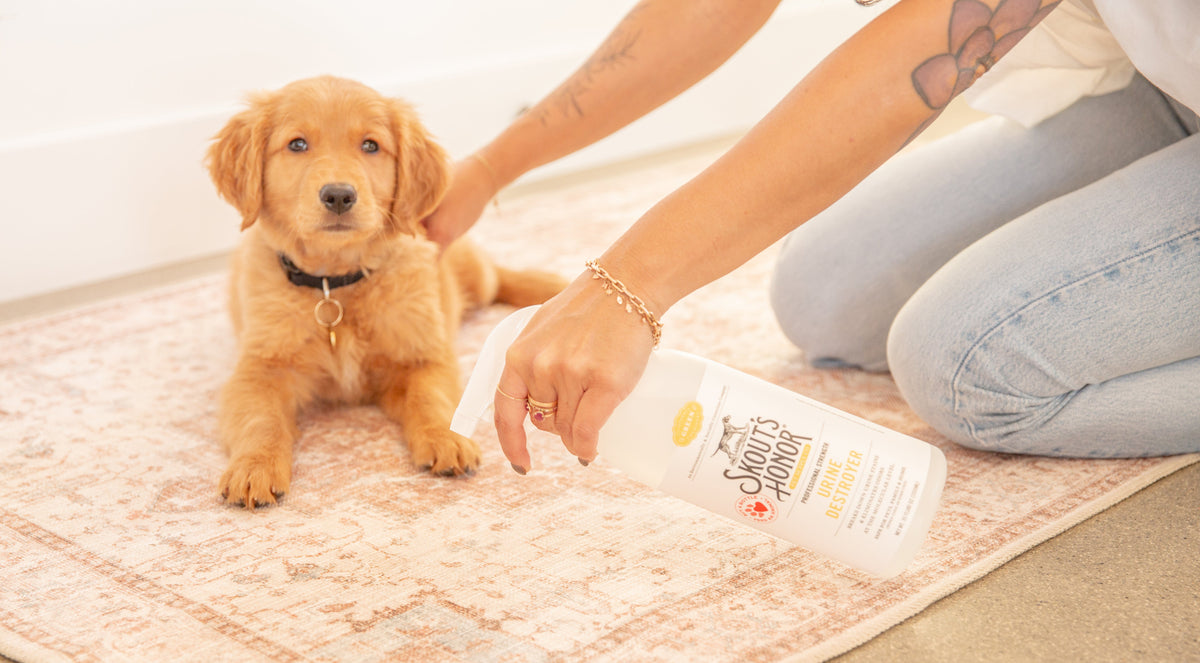
TL;DR: An enzyme-free cleaner lifts stains and breaks down odors with chemistry instead of live biology, so it works on contact, works in any temperature and never expires. Skout's Honor Stain & Odor Remover is our everyday pick: it pairs Bio-Kore®, a plant-based surfactant, with a mineral-based Molecular Deodorizer, and it is safe around pets when used as directed. Enzyme cleaners can work too, but they need long dwell times, the right temperature and a surface free of other cleaner residue. Whatever you use, never mix cleaners, and keep pets off the spot until it dries.
What is an enzyme-free cleaner?
An enzyme-free cleaner is any stain or odor remover that does not rely on enzymes or bacterial cultures to break down a mess. Skout's Honor Stain & Odor Remover is one: the product page says plainly, "our Stain & Odor Remover is not an enzymatic cleaner." Instead, two technologies split the work.
- Bio-Kore® lifts the stain. It is our proprietary plant-based surfactant, developed under California's Green Chemistry Initiative. It works physically, not biologically, lifting the stain off the surface so it blots away, with no pretreatment needed.
- Molecular Deodorizer handles the smell. Our mineral-based odor technology "reacts directly with odor-causing compounds" instead of covering them up.
Ingredients, per the product page: deionized water, Bio-Kore (plant-based surfactant), a biodegradable molecular complex (mineral-based deodorizer) and plant-based fragrance. That is the whole list.
How do enzyme cleaners work, and what are their disadvantages?
Enzyme cleaners use proteins, usually made by bacteria, to digest organic messes into smaller pieces. They can do the job, but enzymes are biological, so they are picky about conditions. Skout's Honor Urine Destroyer skips that pickiness entirely: "Unlike traditional enzymatic cleaners, it never expires" and "is not sensitive to temperature."
The common drawbacks of enzyme cleaners:
- They are slow. Rover advises a 15 to 20 minute dwell, then letting the spot air dry, usually overnight. Consumer Reports says the same: "Enzyme cleaners require a longer dwelling time to work."
- They are mess-specific. Different enzymes target different stains, so one formula may handle urine and stall on grease.
- They are sensitive. Researchers studying detergent enzymes call stability "the key challenge for the use of enzymes in detergent" (Nascimento and Martins, Brazilian Journal of Microbiology, 2006). Heat, cold, pH and leftover residue all play a part.
- They can need repeat rounds. Rover notes stains and odors may take more than one application.
The numbers:
- 9 spray cleaners tested on carpet stained with real dog urine by Consumer Reports (May 28, 2026), which found "enzyme cleaners don't always come out on top"
- 0.3%: above this concentration of SDS, a common surfactant, a detergent protease enzyme was "completely inhibited" (Nascimento and Martins, 2006)
- 5% peroxide solution left the same enzyme unstable
- 15 to 20 minutes of dwell time for a typical enzyme cleaner, plus overnight drying (Rover)
- 5 minutes of wait time for Skout's Honor Stain & Odor Remover before blotting (product directions)
Are enzyme-free cleaners better than enzyme cleaners?
For most real-life pet messes, yes, because an enzyme-free formula does not need perfect conditions to work. Skout's Honor Stain & Odor Remover works quickly, needs no pretreatment, won't expire and "isn't affected by temperature," per its FAQ. That said, "enzyme-free" is a big category, and not every member of it is gentle.
| Enzyme cleaners | Oxidizers and bleach | Skout's Honor (Bio-Kore + Molecular Deodorizer) | |
|---|---|---|---|
| How it works | Live biology digests organic matter | Hydrogen peroxide or chlorine breaks down stains | Plant-based surfactant lifts stains; mineral-based deodorizer breaks down odor compounds |
| Speed | Slow; long dwell, often overnight drying | Fast | Fast; 5 minute wait, then blot |
| Temperature | Sensitive | Varies | Not sensitive to temperature |
| Shelf life | Enzymes lose activity over time | Varies (peroxide breaks down over time) | Never expires |
| Other cleaner residue | Can switch enzymes off | Dangerous to combine with some products | No pretreatment required |
| Surface caution | Not for leather (Rover) | "Aren't always safe for all surfaces" (Consumer Reports) | Not for wool, leather, silk or unsealed wood |
Our take: Our Stain & Odor line has been enzyme-free since this post first ran in 2016, because we wanted a bottle that performs the same in a hot car trunk, a cold garage and the back of the cabinet a year from now. We still think that is the right call. Cleaning up after pets is not glamorous, and you should not have to do it twice.
Are enzyme-free cleaners safe for pets?
"Enzyme-free" alone does not make a cleaner pet safe (bleach is enzyme-free), so check the label. Skout's Honor Stain & Odor products "are plant-powered and safe around pets when used as directed." They are also professional strength, so the label carries a precaution and we recommend applying in a well-ventilated area.
A few habits that apply to any cleaner:
- Read the label. The American Kennel Club notes it tells you whether a product is safe around pets and how to use it.
- Keep pets off the spot until it dries. The AKC says not to let your pet "walk on, sniff, or lick the product while it is wet."
- Air out the room. The ASPCA suggests guiding pets to another part of the house while surfaces air out.
- Questions about exposure go to the ASPCA Animal Poison Control Center at (888) 426-4435.
Yes, your dog will try to inspect the wet spot first. We know.
Can I mix cleaners?
No. Never combine cleaning products, and switch only after the first one is blotted up. Within the Skout's Honor lineup, the Severe Mess Stain & Odor Advanced Formula FAQ notes our Stain & Odor products "can be used interchangeably," so you can grab whichever fits the mess.
- Bleach plus ammonia creates toxic chloramine gases (Washington State Department of Health).
- Bleach plus an acid, vinegar included, gives off chlorine gas. The New Jersey Department of Health puts it simply: "Never mix cleaning products, especially anything containing bleach."
- Enzymes plus other cleaners is not dangerous, but residue from surfactants or peroxide can stop enzymes from working at all.
Which Skout's Honor enzyme-free cleaner should I use?
Start with Stain & Odor Remover for everyday messes, and match up from there. Mud, vomit, the hairball on the one rug that is not washable (never the tile, somehow): this is the bottle.
| Product | Best for | What's inside | Sizes |
|---|---|---|---|
| Stain & Odor Remover | Everyday stains and smells | Bio-Kore + Molecular Deodorizer | 35 oz trigger, 128 oz gallon |
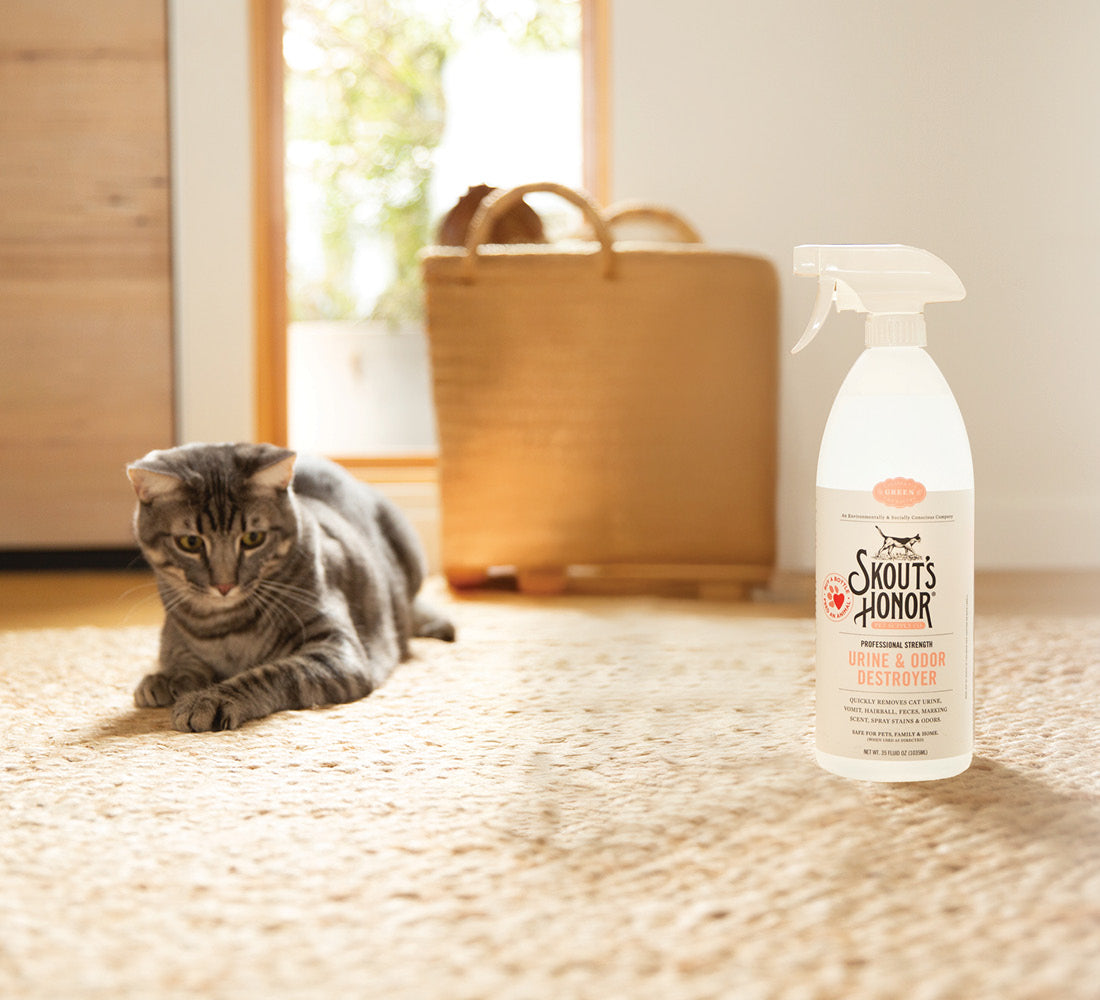
| Urine Destroyer | Urine on carpet, rugs and upholstery | Bio-Kore + Molecular Deodorizer | 35 oz trigger, 128 oz gallon |
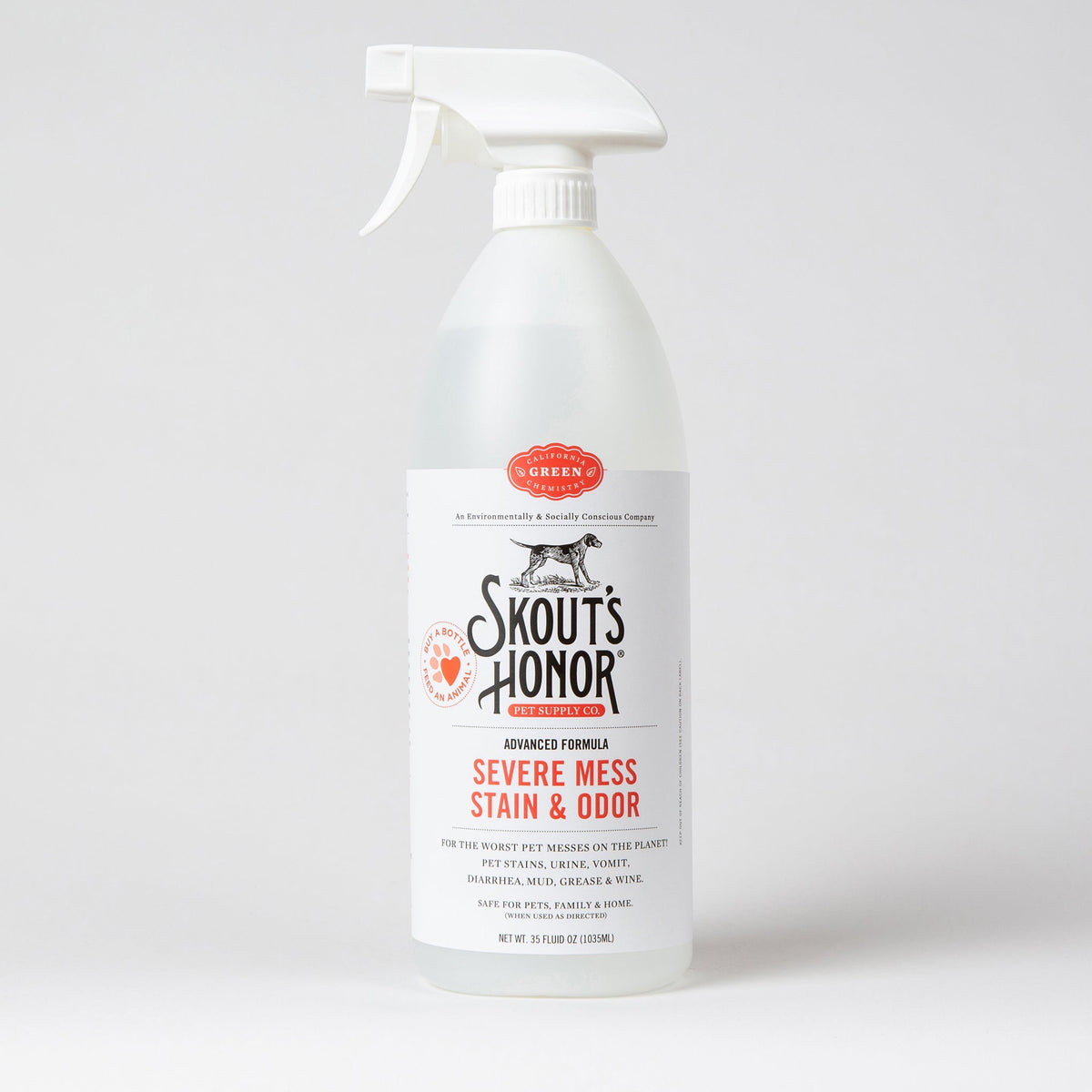
| Severe Mess Advanced Formula | Old, set-in or repeat spots | Bio-Kore + Molecular Deodorizer; our strongest Stain & Odor product | Single or 2-pack |
| Odor Eliminator | Smells with no stain: couches, pet beds, car seats | Molecular Deodorizer only | 35 oz trigger, 2-pack |
Urine has its own quirks, like smells that come back on humid days. Our guide Beyond Enzyme Cleaners for Cat and Dog Urine covers it.
How do I use an enzyme-free cleaner?
Soak it, wait, blot. These are the directions for Skout's Honor Stain & Odor Remover:
- Saturate the spot plus a 1 to 2 inch border. On carpet and upholstery, soak through to the backing and padding.
- Wait 5 minutes.
- Blot up the extra moisture with a colorfast cloth or paper towels.
- Repeat on dried or stubborn stains if needed.
Safe on carpet, rugs, tile, laminate, upholstery, bedding, clothing and hardwood sealed with a water-safe sealant. Skip wool, leather, silk and unsealed wood.
Try this label check on the bottles under your sink:
- Scan the ingredients for "enzymes," "protease" or "bacterial cultures." Any of those means it is an enzyme cleaner.
- Check for a date. Enzyme formulas lose activity with time, so an old bottle may be a weak one.
- Look for bleach, ammonia or acids, and keep those away from each other.
- Find the line about pets. No line means more questions.
FAQ
Is Skout's Honor an enzyme cleaner?
No. Our Stain & Odor formulas use Bio-Kore, a plant-based surfactant, and a mineral-based Molecular Deodorizer. No enzymes, no bacterial cultures.
Do enzyme-free cleaners expire?
Ours do not. Per our technology page, "Bio-Kore® and Molecular Deodorizer do not expire or denature over time."
Can I use Skout's Honor in a carpet cleaning machine?
Yes. Dilute according to your machine manufacturer's instructions, expect extra suds, and finish with a water-only pass.
Do Skout's Honor cleaners disinfect?
No. They are made to remove stains and odors, not to disinfect surfaces.
Bottom line: One bottle that works fast, any season, any year. Start with Stain & Odor Remover, grab Urine Destroyer for accidents, and keep Severe Mess for the spot your dog keeps coming back to.
Sources
- Consumer Reports, "Best Enzyme Cleaners and Oxidizers for Pet Stains and Odors," May 28, 2026
- Nascimento and Martins, "Studies on the stability of protease from Bacillus sp. and its compatibility with commercial detergent," Brazilian Journal of Microbiology, 2006
- Rover, "Do Enzymatic Cleaners Work?"
- Washington State Department of Health, Bleach Mixing Dangers
- New Jersey Department of Health, Hazard Alert: Mixing Cleaners
- American Kennel Club, Tips on Safely Using Cleaning Products Around Your Dog
- ASPCA, Pet Poisons: Household Products and Cleaning Agents, June 4, 2020
Why Is My Dog Scratching If It's Not Fleas?
How Do I Reduce Pet Allergens in My Home During Allergy Season?