

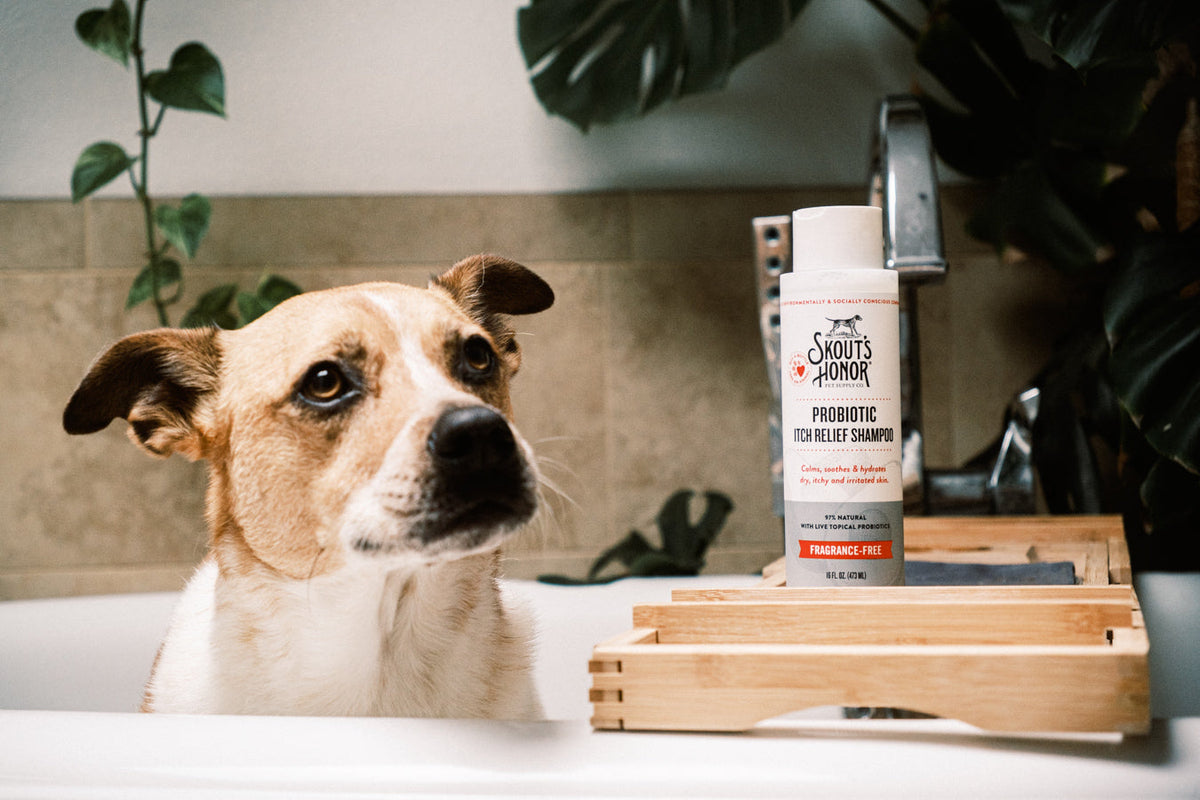
If your dog is scratching and they’ve passed the flea test, the cause is usually the skin itself. Dry skin, seasonal irritants like pollen and grass, or a skin barrier that’s fallen out of balance cover most cases. Ruling out fleas already knocked out the scary answer. The good news? What’s left is fixable, and a daily spritz of our non-medicated Probiotic Itch Relief Spray is an easy place to start.
This post is the “what is going on with my dog’s skin” explainer. Want causes broken down by body part? Our vet-written guide on why dogs keep scratching and biting has you covered. Want a list of things to try tonight? Head to how to stop your dog from itching.
Is it normal for a dog to scratch every day?
A little scratching is completely normal. A pattern is not. Same spot, most days, for weeks is the version worth paying attention to.
Three things separate a normal itch from a pattern:
- Same place. Paws, belly, ears, or the base of the tail, on repeat.
- Same time. Evenings are usually the worst, which is why you always notice it right as you are falling asleep.
- The skin looks different. Flaky, pink, rough, a dull coat, or that smell that comes back before the towel is dry.
One flare after a sprint through tall grass sorts itself out. Three weeks of the same paw does not. And if it feels worse right now, you are not imagining it. Searches for dog itch help go from about 8,100 a month in February to 18,100 a month in July through September. Summer is doing this to a lot of dogs at once.
Can my dog have fleas I cannot see?
Yes, which is why it is worth ruling out properly before you move on. A dog with a flea allergy can react to a single bite, so the itch can be loud while the evidence is basically invisible.
Do the flea dirt test once, do it thoroughly, and then stop second-guessing yourself at midnight. Comb the base of the tail, the groin, and behind the ears with a fine-toothed flea comb over a white paper towel. Wipe any dark specks with a damp cloth. Rust-red smear means digested blood, which means fleas, which means call your vet. Staying black and dry? That is just dirt. Congratulations on the least glamorous science experiment of your week, and read on.
What else makes a dog itchy besides fleas?
Four usual suspects: dry skin, environmental irritants, contact irritants, and a skin barrier that is out of balance. You can narrow it down tonight, no lab required.
Every other article hands you a list of causes and wishes you luck. Here is ours with instructions.
The No-Fleas Itch Audit
| Ask yourself | If the answer is | Look at |
|---|---|---|
| Where is the itch? | Everywhere, or across the back and flanks | Dry skin or a barrier out of balance |
| Paws, muzzle, belly, armpits, the low-riding parts | Environmental or contact irritants | |
| When is it worst? | Year-round, worse in winter and dry indoor heat | Dry skin |
| Spring through fall, worse after time outside | Seasonal irritants | |
| What changed lately? | New shampoo, detergent, bed, or yard | Contact irritant, and the easiest fix here |
| How is the coat? | Dull, smells fast after a bath, shedding is up | A skin barrier out of balance |
That last row is the one almost nobody explains. So let us.
What does the skin microbiome have to do with itching?
Your dog's skin hosts a whole community of microorganisms, and on itchy dogs that community looks different. A 2014 PLOS ONE study led by Aline Rodrigues Hoffmann counted a median of 239 bacterial species on the skin of healthy dogs and 125 on allergic dogs. Roughly half the variety.
There is a lot living on your dog's skin, and that is how it is supposed to be. Crowded is the point. Strip it back with the wrong shampoo and that balance takes a while to rebuild. Cue itch.
This is not a niche problem, either. Nationwide reported in March 2026 that skin allergies were its number one canine claim for the fifteenth year running, across more than 3.3 million claims. The plot twist is that a lot of ordinary grooming products disrupt that balance without meaning to. They clean. They just take the good stuff with them. More on that in why the skin microbiome matters.
Am I accidentally making it worse?
Probably a little, and it is not your fault. The instincts that feel most helpful here are the ones that backfire:
- Bathing more. Reasonable theory. The catch is that you cannot out-bathe a bad shampoo. Sulfates strip skin, and stripping it more often just gets you drier skin faster.
- Grabbing your own shampoo. It is right there in the shower, and it is formulated for a human with opinions about frizz.
- Going for a deep clean formula. Deep clean means built to strip. That is the opposite of the assignment.
- Waiting it out. Fine for a week. After a month it is usually just a loop: itch, scratch, irritate, repeat.
Do home remedies like apple cider vinegar work?
Not really, and one or two can set you back. Apple cider vinegar stings on skin that is already raw. Coconut oil turns into a grime magnet if you get enthusiastic. Oatmeal baths are the kindest of the bunch and genuinely nice in the moment.
None of them touch the actual balance of the skin. Your pantry is excellent for dinner and mediocre at skin care.
What actually helps day to day?
Two habits: wash gently, then keep skin comfortable in between. That is it. Consistency beats intensity every time.
1. Wash with something built for sensitive skin. Our Probiotic Itch Relief Shampoo is non-medicated, fragrance-free, made with live probiotic kefir and aloe, 97% natural, and Microbiome-Friendly Certified, meaning MyMicrobiome independently validated that it does not disrupt the skin's natural microbiome. Prefer one bottle for everything? The Probiotic Shampoo + Conditioner is the everyday 2-in-1 with avocado and argan oils. Fair warning on both: less lather than you are used to. That is the missing sulfates. The suds were always for you anyway.
2. Keep skin comfortable between baths. Our Probiotic Itch Relief Spray is non-medicated, Microbiome-Friendly Certified, 98% natural, and powered by live probiotic kefir with aloe and oat. Alcohol-free, fragrance-free, safe if it gets licked, works for cats, made for daily use. Spritz wherever the action is. Want both? There is a Probiotic Itch Relief Bundle.
The science, kept short: topical probiotics are beneficial microorganisms applied straight to the skin. Ours are live probiotic kefir sealed in tiny beads that stay dry and dormant in the bottle, then break open on contact and release live cultures onto the skin, where they help the natural microbiome stay balanced. Backed by science, powered by nature, and honestly not that complicated.
When will you see something? Give it four to six weeks of consistent bathing plus the spray as needed. You are looking for a softer, cleaner, healthier-looking coat and a calmer dog. Also fewer midnight collar concerts, which benefits the entire household.
When should I call the vet?
If the skin is broken or the behavior has changed, call. Do not wait out anything on this list. Everyday skin care supports comfort. It is not a substitute for a veterinarian.
- Raw, broken, or bleeding skin
- Bald patches or a sudden spike in shedding
- Scratching that is constant or clearly distressing
- Swelling, discharge, strong odor, or any sign of pain
- Itching plus changes in appetite, energy, or behavior
- No improvement after several weeks of a consistent gentle routine
You know your dog better than anyone. If something feels off, go get it checked. A vet can identify allergies, infections, or parasites that need real treatment, and that beats guessing for a month.
Rule out fleas, look at the skin, clean gently, stay consistent, and call your vet when your gut says to. When you are ready to build the routine, here is our probiotic skin care lineup.
FAQ
Why is my dog scratching if it's not fleas? Once fleas are ruled out, persistent scratching usually comes back to the skin: dryness, seasonal irritants like pollen, a contact irritant such as a new shampoo or detergent, or a skin microbiome that has fallen out of balance. Gentle, microbiome-friendly care is where most pet parents notice a difference.
Can my dog have fleas even if I cannot find any? Yes. A dog with a flea allergy can react hard to one bite, so the itch can be severe with almost no evidence. Comb the tail base and groin over a white paper towel, then wipe any dark specks with a damp cloth. Rust-red smear means flea dirt, and that is a call to your vet.
Is it bad to bathe my dog too often? Depends entirely on the shampoo. Sulfates and harsh detergents strip skin, so frequent washing with the wrong formula leaves it drier and more irritated. A gentle, fragrance-free, microbiome-friendly shampoo is made to be used more often without that trade-off.
What is the skin microbiome and why does it matter for itching? It is the community of microorganisms living on your dog's skin. A 2014 PLOS ONE study found a median of 239 bacterial species on healthy dog skin versus 125 on allergic dogs, so the mix genuinely looks different on itchy skin. Products that work with that community instead of stripping it are a different approach to everyday care.
Does apple cider vinegar help with dog itching? It is popular and it is a mixed bag. Vinegar stings on broken or irritated skin and does nothing for the underlying balance, so something formulated for your dog is gentler and more reliable.
Is it safe to use a probiotic spray every day? Our Probiotic Itch Relief Spray is non-medicated and made for daily use. It is alcohol-free, fragrance-free, safe if your dog licks the area, and formulated for cats too.
When should I see a vet about scratching? Call if you see raw or broken skin, hair loss, relentless scratching, swelling, discharge, or any change in energy or appetite, or if a consistent gentle routine has not helped in several weeks. Allergies, infections, and parasites need a real diagnosis.

What to Do When Your Dog Gets Skunked: Effective Tips and Tricks
How Do I Reduce Pet Allergens in My Home During Allergy Season?