
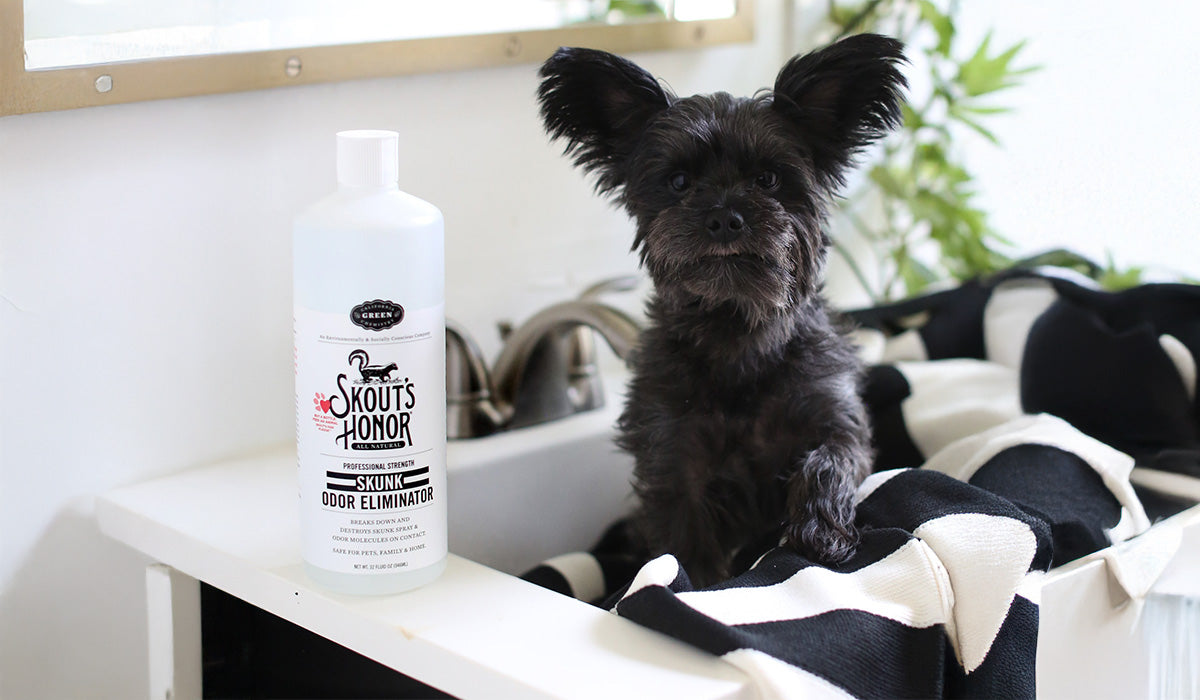
TL;DR (Too Long; Dog Reeks): If your dog gets skunked, keep them outside, check their eyes and mouth, and get a skunk neutralizer on the coat before any bath. Skout's Honor Skunk Odor Eliminator breaks down skunk odor-causing thiols on contact and works on pets and household surfaces. The Got Skunked Bundle pairs it with Probiotic Shampoo + Conditioner and Probiotic Deodorizer for the cleanup after. Skip the tomato juice, and call your vet right away if spray hit your dog's eyes or mouth. Now go get rid of that smell.
What should I do if my dog gets sprayed by a skunk?
Keep your dog outside, check their eyes, then apply Skout's Honor Skunk Odor Eliminator straight to the coat before any bath. Rinse, sniff, and repeat on any spot that still smells.
- Keep your dog outside and leashed. A garage or patio is ideal. Every room your dog runs through is another room to clean.
- Check the eyes and mouth. If they look red, watery or squinty, flush gently with lukewarm water and call your vet (more on that in the vet section).
- Look for bites or scratches. Skunks can carry rabies (VCA), so any wound means a vet visit.
- Apply Skunk Odor Eliminator. Per the product directions, apply it liberally and work it through the coat to the skin, keeping it away from the eyes. Use this BEFORE rinsing with water.
- Rinse well with room temperature water. Then rinse again.
- Do the sniff test. Smell for any spots you missed and repeat as needed.
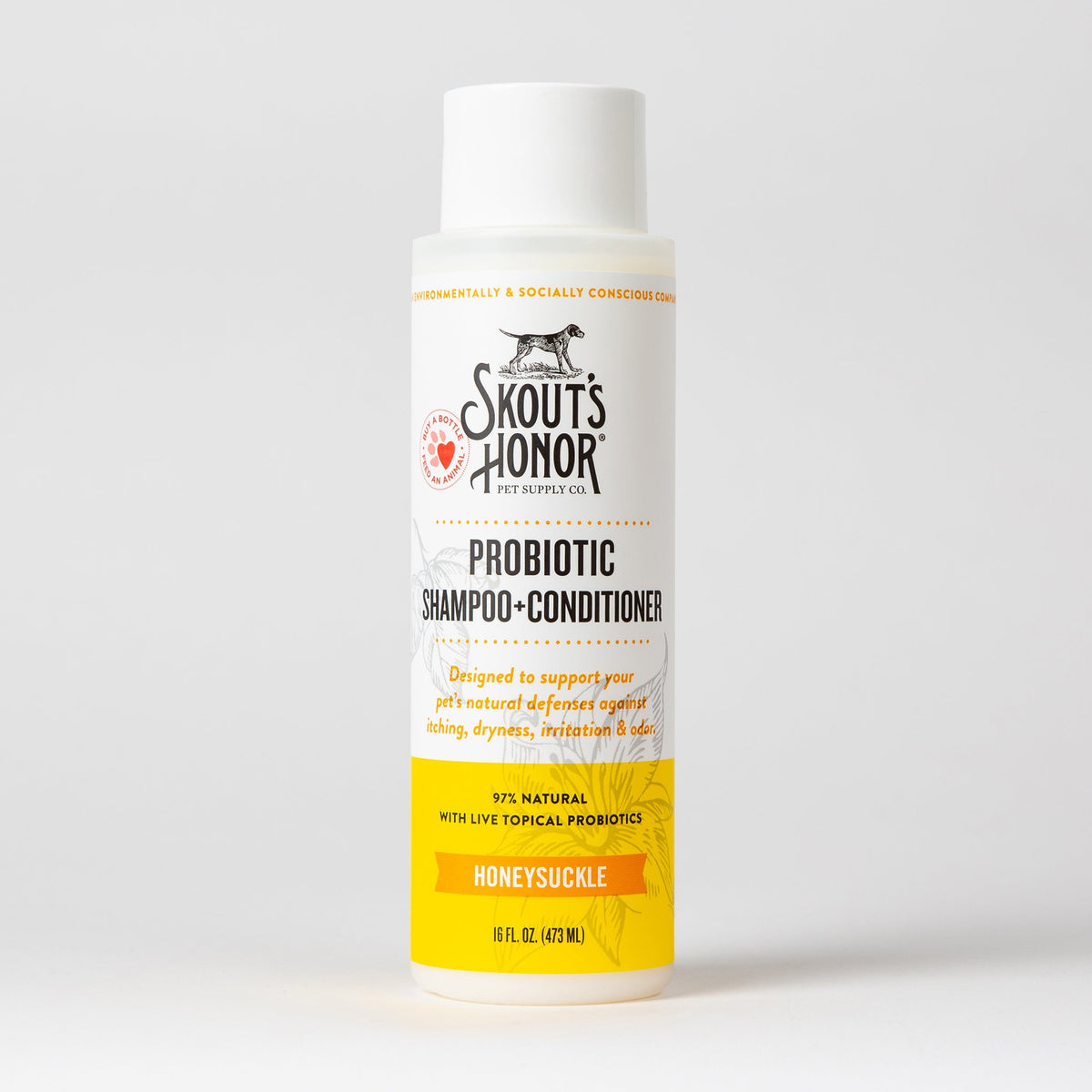
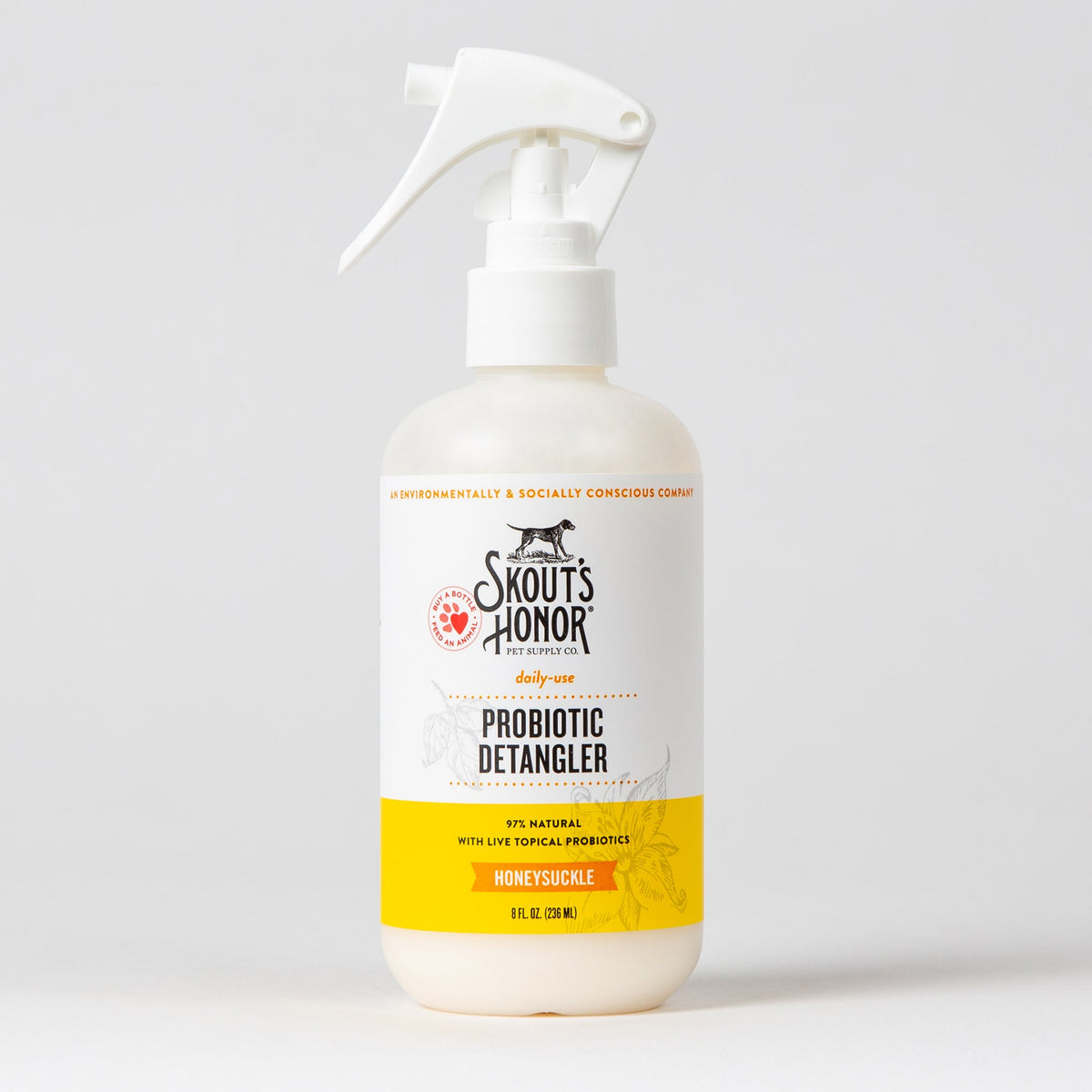
- Finish with a gentle bath. Follow up with Probiotic Shampoo + Conditioner, then dry your dog thoroughly.
Pro tip: leave the good towels inside. This is an old-towel situation.
Should I give my dog a bath right after they get skunked?
Not first. Apply a skunk neutralizer like Skout's Honor Skunk Odor Eliminator before shampoo and water, then bathe. The American Kennel Club advises against wetting your dog before applying a de-skunking solution because "water can worsen the odor."
The reason is chemistry. Skunk spray contains thioacetates, compounds that barely smell on their own but turn into smelly thiols when they meet water (PBS NOVA). Neutralize first, shampoo second.
What neutralizes skunk smell on a dog?
Use something that breaks down the thiols, not something that covers them. Skout's Honor Skunk Odor Eliminator uses a biodegradable, mineral-based molecular deodorizer to break down skunk odor-causing thiols on contact, with no hydrogen peroxide. It is safe for pets, family and home when used as directed.
What is actually in skunk spray, in plain terms:
- Thiols are sulfur compounds and the main source of the smell. Two of them make up 51% to 70% of the spray (dvm360).
- Thioacetates are the slow release. They convert to thiols when wet, which is why a dog can smell skunky again after a bath (PBS NOVA).
- Oxidizing thiols turns them into odorless, water-soluble sulfonic acids (sulfonates) that rinse away. That is how the peroxide recipe works (dvm360).
One customer review on the product page sums it up: "My shepherd decided to befriend a skunk yesterday. We used your skunk odor eliminator and absolutely no smell today."
Does tomato juice work on skunk smell?
No. VCA Animal Hospitals says that "despite the old wives' tale, tomato juice does not work as an odor neutralizer," and vinegar does not either. For a dog that is actually skunk-free, use a neutralizer like Skout's Honor Skunk Odor Eliminator.
| Option | Does it break down thiols? | Watch out for |
|---|---|---|
| Skout's Honor Skunk Odor Eliminator | Yes, on contact | Keep away from eyes; spot test fabrics |
| Peroxide, baking soda and dish soap | Yes, by oxidizing them | Can bleach fur; never store; keep from eyes |
| Tomato juice | No (VCA) | A red, still-smelly dog |
| Vinegar | No (VCA) | Adds a second smell |
| Plain shampoo and water | No | Water can make the odor worse (AKC) |
Is the peroxide and baking soda skunk recipe safe for dogs?
It works, but it needs care. For a ready-to-use option with no peroxide, Skout's Honor Skunk Odor Eliminator is the simpler choice. If you mix the DIY version, follow these safety rules.
The recipe was popularized by William Wood, a chemical ecologist at Humboldt State (Cal Poly Humboldt). VCA describes the common version as 3 to 4 parts hydrogen peroxide to 1 part baking soda, plus about a teaspoon of dish detergent, used while still bubbling.
- Use 3% hydrogen peroxide only. AKC advises nothing stronger.
- Never store it. Mix it right before use. AKC warns that a closed container "risks explosion."
- Expect possible bleaching. Peroxide can lighten fur and fabric. Wood has seen a black lab come out looking more like a chocolate lab.
- Keep it out of the eyes and mouth. VCA says never to use peroxide solutions near the eyes.
How long does skunk smell last on a dog?
It depends on how well you neutralize it. With homemade fixes, VCA says the odor often comes back "every time your dog gets wet over the next few months," which rarely happens with commercial neutralizers. Getting Skout's Honor Skunk Odor Eliminator down to the skin on the first pass is your best shot at a one-and-done.
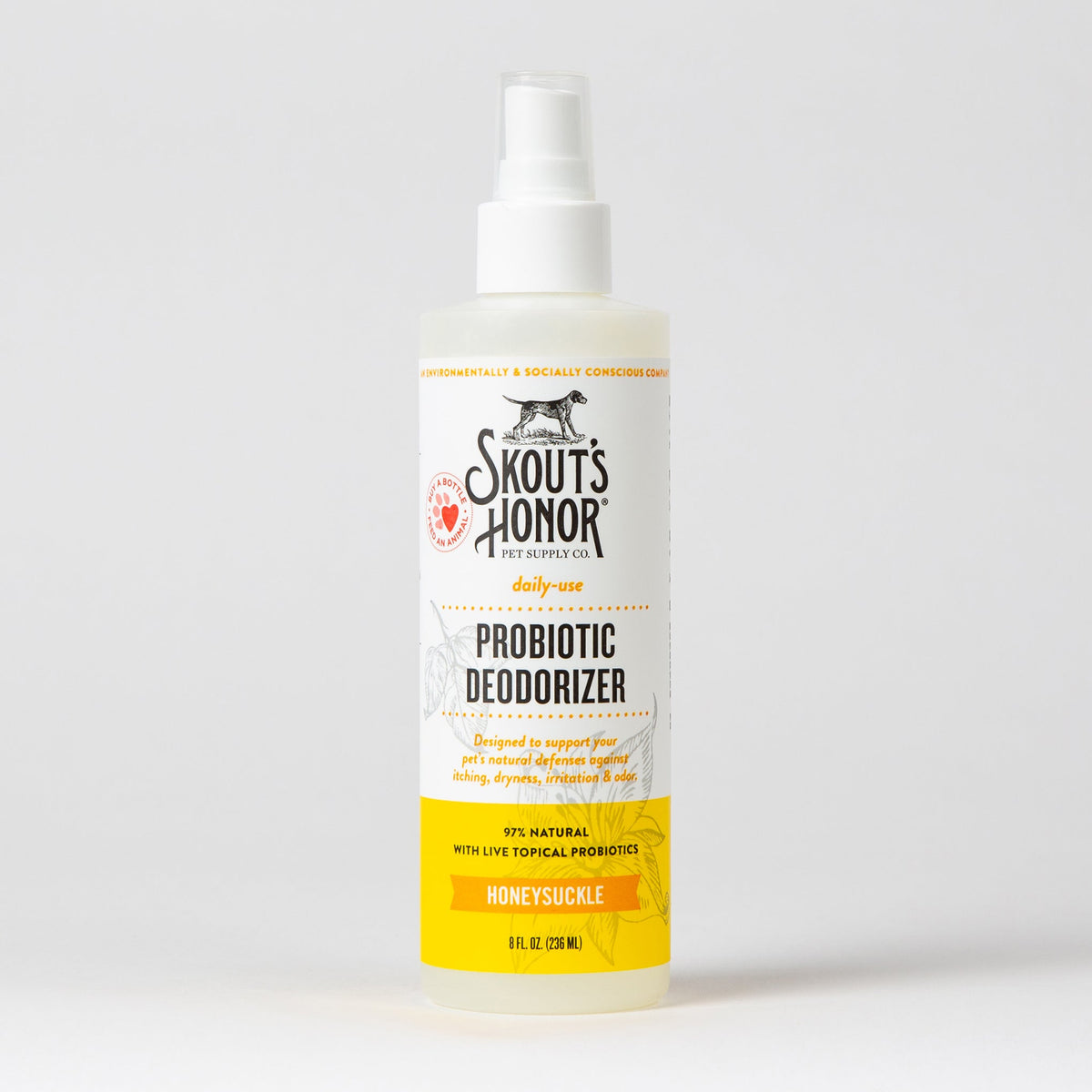
A faint whiff after a rainy walk means thioacetates are turning back into thiols, so reapply on that spot. A spritz of Probiotic Deodorizer keeps the coat fresh between baths.
How do I get skunk smell out of my house?
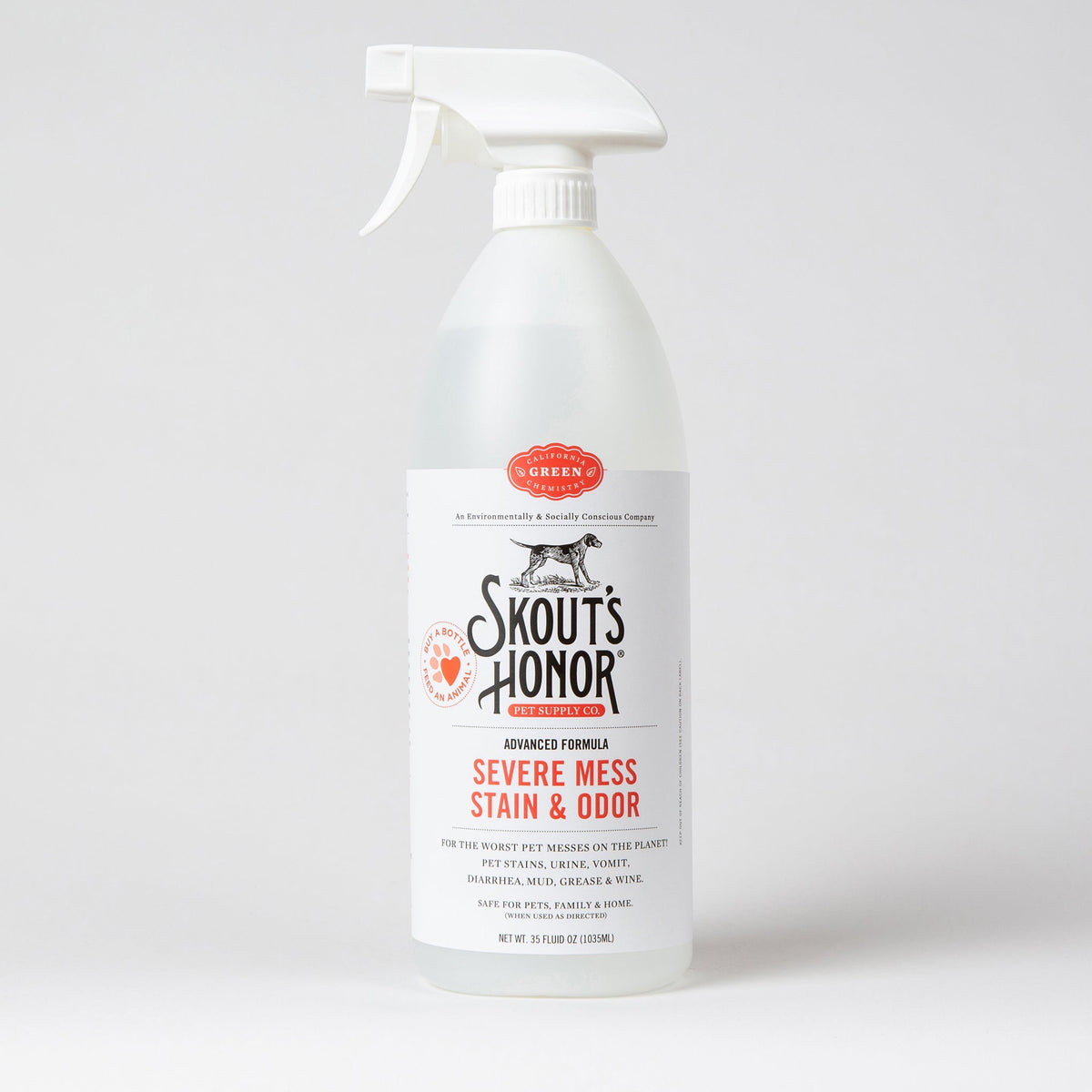
Spray Skout's Honor Skunk Odor Eliminator or Odor Eliminator on anything your dog touched. Both break down skunk spray and odor molecules on contact, without cover-up scents. Then open the windows.
- Safe surfaces: carpet, rugs, tile, laminate, upholstery, bedding and clothing. Skip wool, leather, silk and unsealed wood, and spot test first.
- Fabric and bedding: saturate the area, let it sit about 5 minutes, then wash as usual.
- Collars and leashes: give them the same soak. They hold onto smell longer than you would think.
Odor Eliminator is for surfaces only. Use Skunk Odor Eliminator on the dog.
Which Skout's Honor skunk product do I need?
Start with Skunk Odor Eliminator, since it works on your dog and your home. The Got Skunked Bundle adds the bath and the between-bath freshen-up.
| Skunk Odor Eliminator | Got Skunked Bundle | Odor Eliminator | |
|---|---|---|---|
| Use on your dog | Yes | Yes | No, surfaces only |
| Use on home surfaces | Yes | Yes (via Skunk Odor Eliminator) | Yes |
| What you get | 32 oz bottle | Skunk Odor Eliminator (32 oz), Probiotic Shampoo + Conditioner (16 oz), Probiotic Deodorizer (8 oz) | 35 oz trigger bottle |
| Best for | The first 10 minutes | The whole cleanup | The couch, the car, the dog bed |
When should I take my dog to the vet after a skunk spray?
Right away if spray hit the eyes or mouth, or if you see any bite or scratch. VCA says skunk spray "acts like tear gas," causing tearing, burning and redness, and can damage the cornea. Once your vet has checked your dog, Skunk Odor Eliminator handles the smell.
The numbers:
- 7 to 15 feet: how far skunks can spray (AKC)
- A few hours to 24 hours: when a rare anemia from swallowed spray may show up (dvm360)
Call your vet if you notice:
- Squinting, swelling, redness or heavy tearing
- Drooling, vomiting or repeated face rubbing
- Any sign your dog swallowed spray, since VCA notes it can cause severe anemia
- Any bite or scratch, especially if rabies vaccines are not current
For first aid, dvm360 recommends flushing the eyes with lukewarm water, or use a pet eye wash like HydroClear Eye Wash. Neither replaces the vet visit.
How do I keep my dog from getting skunked again?
Mostly by managing the backyard and the leash. Wood, who has never once been sprayed, says dogs are the ones that "go right for it" (Cal Poly Humboldt). We know the feeling: one good sniff and recall goes out the window.
- Leash up for late-night and early-morning potty breaks.
- Keep trash lids closed and bring pet food bowls inside.
- Keep rabies vaccines current, which AKC calls the biggest concern.
- Keep a bottle of Skunk Odor Eliminator by the back door.
How do I know the skunk smell is really gone?
Our take: the three-sniff test. Rinse with Skunk Odor Eliminator, then check three ways before you call it done. Skunk smell hides where dogs lead with: face, neck, chest and front legs.
- Dry sniff: after the final rinse, smell the face, neck, chest and paws.
- Wet sniff: dampen a small patch on the neck or chest and smell again. If it comes back, thioacetates are still there. Reapply.
- Next-day sniff: check the collar, leash and bedding too. They are often the last holdouts.
Your nose is the best quality control you have here.
FAQ
Can I use Skunk Odor Eliminator on my cat?
The product page says it is safe for pets when used as directed and works on skunked animals. Keep it away from the eyes and follow the label.
Does Skunk Odor Eliminator contain peroxide?
No. Per the product page, it uses a mineral-based molecular deodorizer with no hydrogen peroxide and no harsh chemicals.
Do I still need to shampoo after?
It helps. The product directions recommend following up with a pH-balanced pet shampoo and conditioner such as Probiotic Shampoo + Conditioner.
Bottom line: Neutralize first, bathe second, and leave the tomato juice in the pantry. Keep Skunk Odor Eliminator or the Got Skunked Bundle by the back door, and call your vet if the eyes or mouth took a hit.
Sources
- VCA Animal Hospitals: Skunk Spray and Your Dog
- American Kennel Club: Dog Sprayed by a Skunk
- dvm360: Skunk spray toxicosis: An odiferous tale
- PBS NOVA: The Chemistry of Skunk Spray
- Cal Poly Humboldt: Professor's Skunk Research to be on PBS
Why Is My Dog Scratching If It's Not Fleas?
How Do I Reduce Pet Allergens in My Home During Allergy Season?